
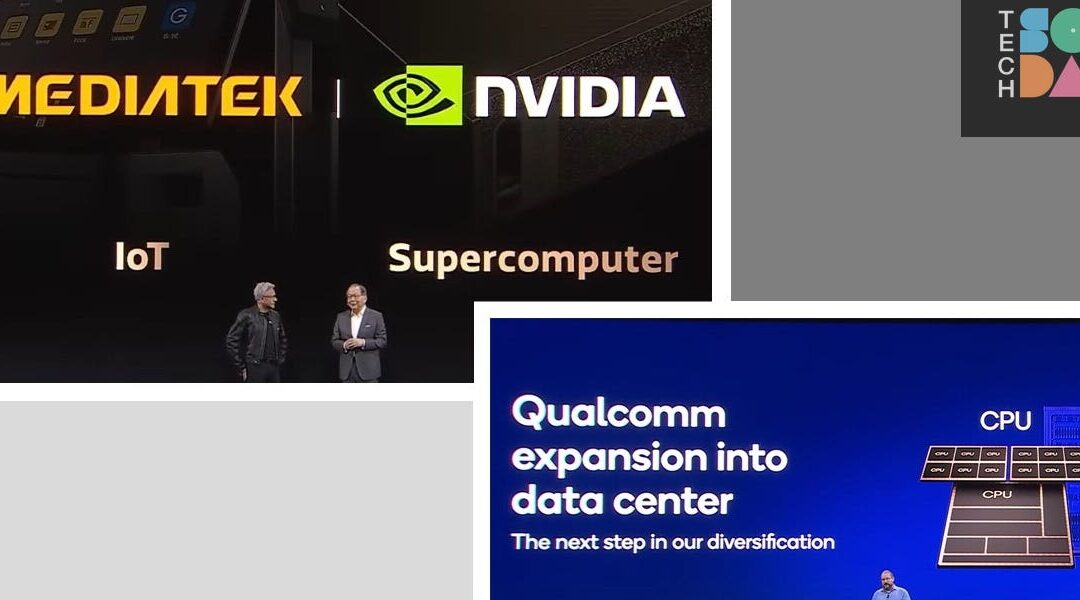
Computex 2025 in Taipei has transformed into the global stage for artificial intelligence breakthroughs, with leading semiconductor companies unveiling their latest innovations. Among the most talked-about announcements were Nvidia and MediaTek, both of which showcased new AI-centric chips designed to accelerate machine learning, power next-generation devices, and redefine computing efficiency.
This year’s Computex has been dominated by AI hardware as the industry shifts from traditional performance benchmarks to intelligent processing capabilities. Companies are racing to deliver solutions that not only enhance cloud-based AI training but also bring powerful inference capabilities to consumer devices, IoT systems, and edge computing environments.
Nvidia Pushes the Boundaries of AI Performance
Nvidia, widely recognized as a global leader in GPU and AI processing, revealed its latest lineup of AI accelerators aimed at both enterprise and consumer markets. According to company representatives, these new processors promise a dramatic leap in computational throughput, energy efficiency, and scalability.
One of the highlights is Nvidia’s focus on AI training clusters for large language models (LLMs). The company’s latest GPU architecture integrates advanced tensor cores, optimized interconnects, and improved memory bandwidth. This makes it ideal for industries deploying massive generative AI models, from cloud computing platforms to advanced robotics.
Nvidia also emphasized the role of its new chips in AI-driven gaming and creative applications. With enhanced ray-tracing capabilities and AI upscaling features, the company aims to blur the line between entertainment and productivity. This dual approach positions Nvidia’s latest chips not only as enterprise-level solutions but also as consumer-ready innovations that bring AI directly to desktops and laptops.
MediaTek Expands Its AI Ambitions Beyond Smartphones
While Nvidia commands attention in the high-performance computing space, https://malaka555.sg-host.com/ has set its sights on democratizing AI through versatile and affordable processors. At Computex 2025, the company unveiled a new series of system-on-chips (SoCs) designed for smartphones, tablets, and smart home devices.
The key highlight of MediaTek’s announcement is its edge AI capability. Unlike traditional chips that rely heavily on cloud processing, MediaTek’s new SoCs are engineered to handle on-device AI tasks, such as natural language translation, image recognition, and personalized recommendations. This reduces latency, improves privacy, and offers users a smoother real-time experience.
The company also introduced AI chips targeted at automotive systems, marking its ambition to expand into connected cars and autonomous driving. With built-in support for computer vision and predictive analytics, MediaTek aims to compete in a market traditionally dominated by Qualcomm and Nvidia.
Industry Trends and the Future of AI Chips
The unveiling of new AI chips by Nvidia and MediaTek underscores a wider industry trend: the shift toward AI-first design principles in semiconductors. Instead of prioritizing raw clock speeds or traditional benchmarks, manufacturers are increasingly focusing on neural network acceleration, energy efficiency, and application-specific optimizations.
Analysts at Computex pointed out that the rapid expansion of generative AI, autonomous systems, and intelligent IoT ecosystems is fueling unprecedented demand for chips that can handle complex workloads with minimal energy consumption. This has led to fierce competition not only among Nvidia and MediaTek, but also with other industry giants such as AMD, Intel, and Qualcomm, all of whom showcased AI-driven innovations during the exhibition.
Another key theme at Computex 2025 is collaboration across industries. Chipmakers are working closely with cloud service providers, automotive companies, and device manufacturers to ensure their AI hardware integrates seamlessly into diverse ecosystems. This cooperative approach is expected to accelerate adoption and push the AI chip market to new heights in the coming years.